Sunday, 11 May 2014

Highgate Harriers Night of the 10,000m PBs


For anyone enthusiastic about athletics and wanting to watch some of the best domestic talent race around 25 laps of the track, Hampstead Heath track was THE place to be last night. After the success of last year’s ‘Night of the 10,000m PB’s’, Ben Pochee and his team at Highgate went one step further to deliver, what I thought, one of the best track events I’d ever been to. A giant TV screen, inspirational tunes picked by the athletes playing out, BBQ, beers, and 300-400 people cheering from lane 4, all helped to create a fantastic atmosphere for the 125 athletes competing across each of the 5 10,000m races.

A strong wind didn’t make ideal conditions for PB's, but the very fact that each race had been carefully seeded, meant that individuals were competing against others of a similar standard and hence likely to encourage faster times.

I was in the men’s B race and looking to break 31 minutes. I thought I may as well go for it at the start, use the group to help drag me around and, in particular, shield me from the gale in the finishing straight of each lap. This was fine up until 5k, which I reached in about 15:15, however the quick early pace hit me from 5-8k, where I lost the wind shield and started to go backwards. Despite the sub 31 target drifting away, the music playing out and crowds of people supporting on every lap helped push me along and I was able to pick up the pace for the last 2km, eventually finishing in 31:27. Slightly disappointed, but still a 2 minute PB on the track.

Then it came to the 2 main races of the evening, the women’s and men’s A races. Assembled on the start lines were athletes that have been to the Olympics, Commonwealths, World Championships, and several of which were aiming for a European Championship 10,000m to be held in Zurich this August.

Jo Pavey and Sophie Duarte took it out on the first half of the women's race, closely followed by Fionuala Britton. However it was the pace that Jo Pavey continued to knock out the laps at that eventually broke her away from the field to take victory in 32:11. This not only achieved the sub-33 minute Euro qualifying time but also recorded a W40 British record by over 2 minutes.


In the men's A race, the AFD duo of Andy Vernon and Chris Thompson pulled clear of the rest of the field early on and appeared to have a sufficient break. But Johnny Mellor worked hard to reel them in, at which point Andy Vernon launched an effort, broke away and started his run of 67ish second laps. The battles at both the front and mid pack were keeping the crowd entertained as the atmosphere on and around the track continued to build. However, on the night, Andy Vernon was a class above the rest, and obviously in great shape following his recent 13:11 5k, he clocked a 28:26, ahead of Chris Thompson (28:49) and Johnny Mellor (28:52) who battled it out for 2nd and 3rd respectively.

All in all it was great to see domestic athletics so well supported, and huge respect to Ben Pochee for organising the whole event. Hopefully there’ll be more to come again in 2015!

Monday, 28 April 2014

6 races in 3 weekends

After a slightly disappointing February and March, a decent 6 races in the past 3 weekends has given me the enthusiasm to update the blog.

Earlier in the year I’d steadily increased my mileage up to 80 miles per week, things were going well, I had plans to have a crack at the London Marathon and I had a string of good race results in January. However, I knew I was pushing the mileage too high and unsurprisingly soon found myself injured. Marathon plans abandoned.

So come the middle of March, I decided to re-assess my training and took on a ‘sessions only’ approach, whereby I’d run hard 3-4 times per week and replace any steady running with time on the bike or swimming. An unconventional approach, but if it means staying injury free, then I’ll take it. I’ve relaxed this slightly in the past couple of weeks and worked in some steady runs, but my training now seems to favour the bike, doing about 40 and 160 miles per week running and cycling respectively. This seems a bit convoluted given that I’m training for running races, but I find cycling out in Richmond Park in the morning before work is too bigger draw.

Anyway, here is a summary of my 6 races:

Winchester Parkrun (12/04/2014): Race/run/Saturday morning outing

London Marathon (13/04/2014):  I felt like a little bit of a fraud lining up a Blackheath knowing that I was going to pull out somewhere between 13 and 15 miles felt, but conditions were great and I thought it was a good opportunity to put in a decent tempo run. I ran with my training mate Jonathan Poole and Highgate Harrier Richard Scott for most of it. These two guys know how to pace a marathon and and sticking to a metronomic 5:25 mile meant we hit half way in 70:48 and they went on to run 2:22 and 2:24 respectively. There was a small inclination to carry on and complete the full 26.2 miles, but I took the sensible approach and forced myself on to the side of the road just before the 15 mile point. Pleased with the effort and should provide some endurance without feeling the effects of a huge mileage.


Isle of Man
Did it really take 3 years to recover from my last trip to the Isle of Man? It’s a class place to spend the Easter break if you like running and drinking. A look at the entry list suggested competition for the Festival would be strong and so it turned out to be.

Port Erin 10k (18/04/2014): The Friday night 10k in Port Erin is the one opportunity where most people are completely fresh and have no ill effects from the day before. Conditions were near on perfect for the undulating course and, after an early breakaway by Adam Grice over the first 400m, the pace settled down. Despite a fair climb out of Port Erin, the leaders still went through the first mile in sub-5 minutes and a sizeable lead pack (8-10) stayed together and went through half way in about 15:30-15:40. At this point, Alex Short, Glenn Phair, Matt Leach and Will Mackay started to pull away from me and I became a little isolated for 7-10k, but knew that Andy and Dave Norman were only just behind and this helped force me to maintain the pace. The course continued to undulate in the second half of the race and there was speculation whether the slightly different route made it tougher than usual, however a steep descent back into Port Erin meant a quick run in to the finish where I came 5th in 31:41.


Peel 3.5 mile Fell Race (19/04/2014): Saturday afternoon in Peel is the venue for the 3.5 mile fell race. I’d not run a fell race since the last time I was here in 2011 and conditions were pretty similar: dry and breezy. The first climb is bloody hard work for someone used to running up and down the Thames Path, and I found myself in 4th at the top. The 10k winner, Alex Short, and my club mate and NZ mountain runner, Glenn Hughes, battled it out for much of the race ahead of me. I went into third spot ahead of Matt Leach at the top of the second climb, but the Cambridge guys took it out on the final descent and pushed Glenn and myself back into 3rd and 4th respectively.


4*5k Relay (20/04/2014): Assembled on Douglas Promenade on the Sunday morning were a fair few blurry eyed runners ready to take on the 4*5km relay up and down the sea-front. The 10 mile pub crawl back from Peel coupled with the fell race was hardly the greatest preparation for a 5k, but mostly everyone was in the same state. A very strong headwind from Douglas out to the far end of the course meant that no one was that willing to take it on and hence we opened with a relatively slow 5:15 mile. At the turn around and as expected, the pace increased rapidly. Alex Short immediately put a decent gap between myself and Glenn Phair and went on to had Cambridge over in 1st place. The tail wind helped me clock a 4:39 mile on the way back, although I struggled in the final kilometre, getting overtaken by a couple of guys, losing a bit of ground on Glenn and eventually finishing in 15:31. By the third and forth legs, Cambridge and Doss were well up the road and took first and second respectively, whilst Serpentine held on to 3rd, only 10 seconds ahead of Manx Harriers.

Ful-on-Duathlon (27/04/2014): Given the fair amount of cycling I’ve been doing recently, it seemed sensible to have a go at a duathlon. The 6k/23k/6k race took place at Dunsfold Aerodrome, AKA the Top Gear track. My strategy for the race was fairly simple: go out hard on the run, ease off a little on the bike and then do the second run in as close a time as possible as the first. It more or less worked out that way; I think that the bike could have been a little quicker had I actually got the TT-bike set up right, but that’s what you get when its not ridden for the winter. I landed up finishing first about 3 minutes ahead of second, although my lap time was way off the pace to make it onto Clarkson’s list.


So a fairly busy last few weeks and, despite this, I’ve got no niggles or pains so this bodes which I’m happy about. The next race is the Highgate 10,000m where I’m aiming to go sub-31. The elite race (which I won’t qualify for) should be great to watch.

Monday, 30 December 2013

2013 Review - A year to concentrate on multisport

For a year 'off running', 2013 has gone well as I've looked for other events to aim for. At the start of 2013,  I wrote down my targets for the coming year and these were mostly focused on triathlon. At the time, I had just been diagnosed with a stress fracture in my back and so I concentrated on cross training, (and in particular rowing), in order to keep a decent base level of fitness. I'd done a bit of rowing on a Concept 2 in the past, and quite how transferable it is to running/cycling I don't know, but I decided that it was the most efficient way to have a decent workout in the shortest possible time. By mid February, and having become quite bored of looking at a Concept 2 'row-ometer', I'd recovered from the back problem and started to get out running again. I was pleasantly surprised with my run at Eastleigh 10k in March, and it made me realise that, as long as you stay in a reasonable shape cross training, the ability to regain running fitness seems relatively easy.

The come back was short lived though as the next injury in my bucket list was a problem with my knee, which kept my running mileage very low from April through to November. However this was when my aim to compete in the World Age Group triathlon champs really started to take off and the first qualifying race was approaching. The Deva Triathlon was a real eye-opener as I failed to qualify and it made me realise that my cycling was not up to scratch if I wanted to race in Hyde Park. So it was time to put some serious time in on the bike!

Throughout June, July and August I made a concerted effort to get out on the bike most mornings into Richmond Park and clocked up around 3,000 miles over these months. This was at the detriment of my running however the time saved on the bike was far greater to that lost on the run and, during this period, I managed to secure a place for the Hyde Park triathlon.

September came, I was in my best ever cycling shape, and the World Age Group Triathlon could not have gone any better. It certainly was the climax of the year.

Perhaps it was not a coincidence that, as I reduced my training time, the problems with my knee improved and I was able to start running again during November. The turning point was running a decent race at the December Hampshire League XC having already raced that same morning (certainly not text book, but I felt no pressure to perform at either). Now coming off a number of 60+ mile weeks, I feel as though 2014 is a year to revert back to running, but it's bound to have the odd duathlon and triathlon thrown in.

Sunday, 10 November 2013

Ballbuster Duathlon

In terms of the tougher races that I’ve competed in over the past few years, the Ballbuster Duathlon has to be up there. As if I didn’t get the message last year, 8 miles of running, followed by 24 miles of cycling and then another 8 miles of running doesn’t sound the most appealing thing to get up for at 4:30am on a Saturday morning, however there is something quite iconic about doing this race on an undulating and technical course around Box Hill.

Given that it takes place in November, chances are that it’ll be cold, raining and there’ll be a lot of debris on the road, and so kit selection is very important to make sure your body temperature is correct for each discipline.

Fortunately it wasn’t raining when we started and I set off on the first run at a fair pace. I ran much of the first run with my club mate Alan Murchison and we soon put a gap between ourselves and the rest of the field. Given the first 5 miles is downhill, passing through this distance in 26:40 was relatively quick, potentially a little too quick given that there was still 2 hours of racing left, but I expected there to be some handy cyclists out there and so tried to give myself as big lead as possible. Obviously the first run also gave me the opportunity to see what the road surface was like for the bike and, quite frankly, it was asking to be slipped on if you weren’t going to take corners carefully. I pushed the pace on up Zig-Zag climb and put 30 seconds between Alan and myself before starting the bike course.

I used a time-trial bike after a lot of debate on equipment choice. I thought the aerodynamic benefits could well be over-ridden by a road bike given how difficult a TT bike is to control in the wet and the very fact that the brakes are a long way away when you are on the aero-bars. I felt as though I made the right choice, spent only a limited amount of time on the aero-bars and took every corner very, very carefully. The first lap was the quickest as there was no race traffic to contend with and I maintained an average of about 21mph. I held back to a certain extent given how much debris there was on Lodgebottom Road (the narrow road around the back of Box Hill) and at no time did I feel out of control. The second and third laps were technically harder as there were others competitors in the race on earlier laps to overtake and, with the possibility on traffic coming in the other direction, I spent less time on the aero-bars and more time ready to have to put the brakes on. At the back of my mind I was half expecting Hugh Mackensie to come past as was the case last year, however he only managed to close the gap to about 30 seconds on the bike.

By the time I started the second run, it had started to drizzle and the temperature dropped like a stone. My feet were numb and I was not exactly ‘with it’ for the first mile. In fact, I completely stacking it for no reason at all, landing on my hands and picking up some grazed knees in the process. Perhaps that got some adrenaline going as, after that point, I began to get my running legs back and was able to pick up the pace. I had no idea how far behind second place was and so just kept pushing as hard as possible; I also had half an eye on the course record. Support from other cyclists still on the bike stage was fantastic and the second run up Box Hill was not too punishing given I knew the end was only about a mile away.


I finished first in 2:35:28, which apparently was about 40 seconds outside the course record. Hugh Mackensie was second in 2:40:44 and Alan Murchison third in 2:45:45. My legs are now in pieces, so I reckon a couple of easier weeks are called for.

Run 1: 00:42:58
T1: 00:00:31
Cycle: 01:07:41
T2: 00:00:39
Run 2: 43:37

Sunday, 15 September 2013

World Age-Group Triathlon Champs: Job Done!


I’ve not concentrated and prepared so much on a race since the London Marathon 2012, so its not surprising that, in the past few days, I’ve been feeling a combination of nerves and excitement. Today started early catching the N19 night bus, along with a few dishevelled part-goers, to Hyde Park and then preparing my bike in the dark ahead of the race. It was cold; in fact the air temperature was so cold that the organisers shortened the swim by half to 750m. Personally I felt as though this played to my advantage and was relatively unfazed by the decision. As it happened, by the time my wave started at 7:45, I think it would have been fine to swim the full distance, but the decision had already been made. The great thing was that it was dry, not windy and we had clear skies to race in.


I’d been told to go hard from the gun on the swim, so I tried my best to latch on to someone else’s feet and gradually work my way through the field. The usual barging and bashing continued up until about 500m, and it was only towards the end that I managed to pull myself clear of it. I must have finished the swim in about 15th.

Transition was long, both in terms of how far you had to run and the time it took me to take my wetsuit off. Needless to say, mine was far from textbook and there is still plently of room for improvement there.

The bike course was fantastic; riding down Birdcage Walk, Whitehall and the Embankment all on closed roads. Frustratingly I did not have my Garmin on, otherwise I’d have definitely been out Strava segment hunting! Although I am strong on the run, I knew there would be other triathletes out there capable of posting a sub 33min time for 10k, so the aim was to try to make as much time up as possible on the bike. I went past Danny Russell (Highgate runner who I knew had run a sub-15 5k this summer) after about 8k and felt as though I needed to finish a good minute ahead of him on the bike given his running ability. At about 10k, I went hard over a bump and my seat post dropped by about 1.5 inches, which didn’t seem to impact my speed too much, rather it just made my bike position a little uncomfortable. I finished the bike in about 10th, ahead of a sizeable group of riders and then hit the run.

The run course was busy from the other waves, although there was still plenty of space to pass people and I so worked my way through the other runners. After just over a lap, Danny Russell came past me and I tried to keep up with him, but he was just too strong. It did give me a target follow and I made it my aim to keep him in sight. There was a lot of people out there cheering on the course and apologies if I didn’t acknowledge everyone supporting that I knew, lets just say I was well in the zone by this point. I didn’t feel as though my pace slowed throughout the run, in fact I finished with a sprint crossing the line in 1:49:33 which gave me 6th place in my age-group, 18th overall and 7th out of the Brits. A great day out, event and experience all round!

I’d certainly like to do more age-group races again and hopefully it’ll lead to other multisport opportunities. I’ve had a lot of help along the way, in particular from Alan Murchison for helping arrange a time-trial bike and some pacey cycle rides, my firm Capco for their support towards a time-trial bike, my parents for helping with all sorts of logistical things around training, my training mates for joining me on any cycles or runs, and all the support today to help get me round. Thank you!

Thursday, 12 September 2013

Build up to Age-Group Triathlon Champs: Part 2

This Sunday I'm competing in the world Age-Group triathlon championships in Hyde Park. I've written a couple of blogs this week for Financial News to illustrate how someone working in the city balances training for triathlon alongside a day job. I thought I would post them on here too, so here is part 2 about my aims for the race and how I've prepared over the past month:

"With just days to go until the race on Sunday, I've started to think about where I would like to place in the field and what sort of time I hope to achieve. At the British Triathlon Championships in Liverpool, where I qualified for this week's event back in July, I finished 14th overall with a time of 1:57:17 - just under 2 minutes behind the winner.

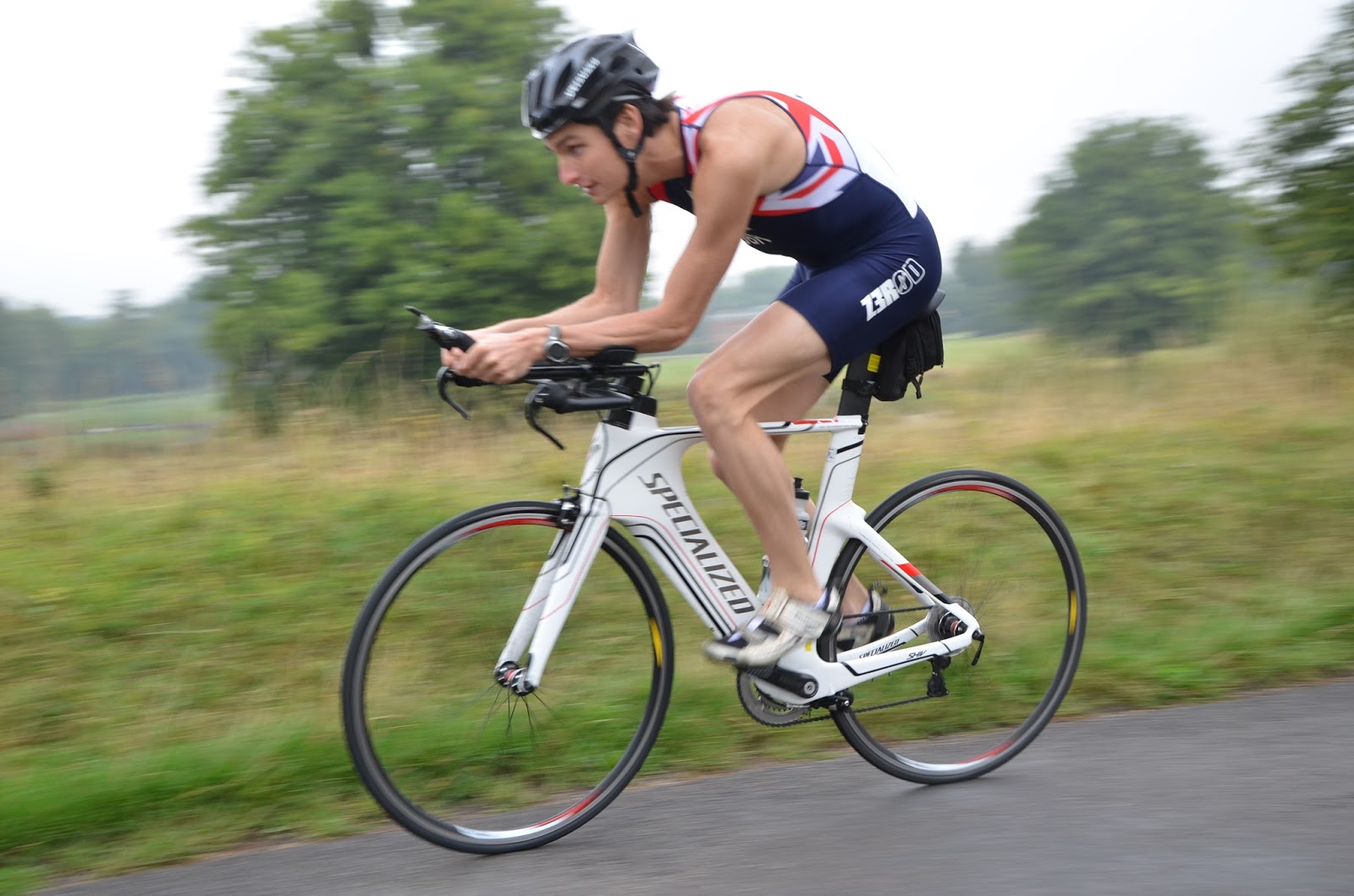
Since then, I have invested in a 'Specialised Shiv', which is a time-trial bike and therefore a lot more aerodynamic than a standard racing bike. This was made possible thanks to an award given to me by Capco for services to our clients.
Managing to compete and carry out the required training alongside my day job requires a well-structured day and an understanding among my team about the demands I have outside work. The hardest part is when a work deadline comes up and my training needs to be shifted, although being able to incorporate my training into my cycling commute to and from work often helps to avoid missing a session altogether.

I have also invested in some deep-rim wheels and clocked up many more miles swimming, cycling and running. The aerodynamic design of a time-trial bike provides a significant benefit and the deep-rim wheels reduce turbulence, both of which should help increase my speed on the bike. As part of my final preparation, I have also made sure to run at least once a week at race pace. This should help ensure that I am familiar with the speed I need to achieve when I run off the bike.

It is hard to estimate what my total time to complete the race will be as every triathlon course is slightly different, but I am aiming to finish comfortably under two hours, which will hopefully put me in with the sharp end of my 30-34-year age group.

Obviously, the rest of the GB age-group team and competitors from the rest of the world will have been training hard to be at their peak performance for this event and, as a result, the level of competition is likely to be very high.

Similar to my preparation for any other significant race, the last seven days of training is relatively straightforward.
With the hard work done and the miles in the bank, it is important to allow your body to shake out any fatigue so that you are fresh for race day itself. My plan was to swim at a relatively easy pace a number of times, run once or twice, and make sure that my bike is working perfectly. I also aim to eat and sleep well, as these are two important factors in the final preparation that can be easily overlooked.
Overall, I feel ready, my training has gone well and now it is a case converting my efforts of the past four months to performing in the race itself."

Build up to Age-Group Triathlon Champs: Part 1

This Sunday I'm competing in the world Age-Group triathlon championships in Hyde Park. I've written a couple of blogs this week for Financial News to illustrate how someone working in the city balances training for triathlon alongside a day job. I thought I would post them on here too, so here is part 1 about my training:

"Having stepped up from the marathon to compete at triathlon this year, I have had to adjust my training, which has previously focused on running, to incorporate two further disciplines.
My background in athletics has allowed me to appreciate the volume and type of training required to be competitive at running, and I have converted this knowledge to help prepare for the swim and the bike.
Intensities across the disciplines vary - for example an hour's steady running can be equivalent to three hours of cycling, and I find myself far more fatigued after an hour's run compared to an hour's swim. As a result, I have found the duration of training for triathlon to be significantly longer than when I concentrated solely on running.
It is important to focus on the discipline where more training can make the greatest difference. This may not always be your strongest discipline, and the other two disciplines may slip as a result.
I have made a concerted effort this year to improve my cycling, which has come at the expense of becoming slightly slower at running and swimming, but achieving a faster cumulative time overall. To put it in perspective, in the three months leading up to the London Marathon in 2012, I ran 720 miles and cycled a fraction of that, while in the three months before this Sunday's age-group triathlon I will have run just 150 miles but cycled 2,750 miles.
So what does a typical week's training look like for me? Here is a sample from July:
  • Saturday: 3km swim in the morning, 40-mile bike ride in the evening
  • Sunday: 20-miles on the bike in the morning, including a 10-mile Time Trial and followed by a 3-mile run. A 30-mile bike ride in the evening
  • Monday: 3km morning swim, 8-mile run in the evening
  • Tuesday: 25 miles on the bike in the morning, strength and conditioning work in the evening
  • Wednesday: 3km swim in the morning
  • Thursday: 23 mile bike ride in the morning, 8-mile run in the evening
  • Friday: 30 miles on the bike in the morning
  • As well as this, I commute to and from work by bike, which adds another 55 miles

This particular training schedule works for me and I structure it around my working day. It requires getting up at 5:45-6:00am every day to ensure I have enough time to exercise before work, and a degree of self-discipline is needed to train again in the evening, but I find the end-goal provides enough motivation for this.
I started to ramp up my training in May and have kept it up for the whole of the summer. Now, with just days until the race, I can begin to taper knowing that I have done as much as I can to prepare."

Here is the article online