Saturday, 1 December 2012

Seb Coe book review and another bike crash

What is with me and falling off bikes? Yes, this week I had another accident on my bike. Someone who'd had a few drinks decided to cross the road without looking just as I was cycling past and I had nowhere to go but straight into them (they came off fine). A trip to A&E, 5 stitches on my chin, a bashed calf muscle and a few other grazes has sidelined me for the week, but I'm hoping to be running again in the next 7-10 days.

I'd just come back from warm weather training in a resort called Las Playitas in the Canary Islands. Its a really good set up with some great running trails, gym, sportshall and 50m pool, and it alowed me to put in a solid week's trainign along with a load of sleep and relaxing. While I was there I read Seb Coe's autobiography 'Running my Life' and here is a short review of what I thought of the book:


From setting 3 world records in the space of 41 days to being one of the key figures to deliver the 2012 London Olympics, Seb Coe has some significant achievements to his name. Unlike many celebrities, Seb Coe started to achieve big from a relatively young age; he was just 22 when he broke his first world record. This makes his autobiography a thrilling read based upon his achievements from the past 30 years.

The book is essentially split into 3 main sections: his life as an athlete, his life as a politician and his role in the run up to the 2012 games. It provides an insight into what is required of a full time athlete, his relationship with his father (who was also his coach) and the influences of others within athletics to make the early 80's possibly the most competitive period for middle distance athletics.

We read about his time as an MP and the difficulties he has in balancing both work and family commitments. For me, this was a part of his life that I was most unfamiliar with. However, from reading the book, it is clear that the skills he learnt during this period were instrumental in helping him deliver the London 2012 Olympics.

And finally we are reminded of his role at the Games, how the bid was won in Singapore in 2005 to the closing ceremony of the Paralympics. It's fascinating stuff, and also brings back memories of a great summer of sport. There is still a gap for somebody (such as Paul Deighton, CEO of LOCOG) to do a complete analysis of the games, however it's quite right that Seb Coe does not go into this great detail here.

Likewise there is limited controversy in the book, and I would not expect it to appear in an autobiography for somebody with potentially so much high level exposure ahead I them. However, it does recognise events that have indeed challenged the author and leaves the reader to research further on them if required. As a runner, there were large parts of the book that I could directly relate to, but I would think that a non-runner following sport and sporting achievments would find it just as interesting.

Who knows what else he might achieve? President of the IOC is possibly up there but, even at the age of 55, this book still describes a very interesting life so far and is definitely worth a read.

I'll leave you with a clip showing some of the battles between him and Steve Ovett from 1980: http://www.youtube.com/watch?v=txkz8VLO3iE

Saturday, 24 November 2012

Duathlon Racing

It was after the first Met League XC when I was in the pub with Rich Phillips and he mentioned to me that he'd entered the Ballbuster duathlon. I'd never actually done a duathlon before and the prospect of 16 miles running and 24 miles cycling was pushing the sort of endurance required for a marathon; certainly not the focus of my current training. Having been convinced the course favoured runners and followed the same stunning route that the Olympic Road Race took around Box Hill, my name was down for it. I then convinced my Winchester club-mate, Alan Murchison, who has been trying to get me to race a duathlon all year, to sign up as well; he too was equally apprehensive about the 16 mile run.

The previous week Rich and I had gone to recce the bike course. It was a filthy wet Sunday, the road was covered in leaves and, if it was like this the following week, coming off the bike could be quite likely. It was good to get an understanding of the course, where you could push it on the bike, where you needed to hold back and the magnitude of Box Hill.

Roll on a week and we were fortunate to have a stunning November morning. Temperatures were only just above freezing, but it was clear, dry and the organisers had done a good job of clearing the debris from the road. With the race starting at 8am, my alarm had gone off at 4:30am to give sufficient time to arrive on the start line fairly relaxed.


Having to prepare for both 16 miles running and 24 miles cycling meant getting the right clothing was key: too many layers and you'd overheat on the run, too few and the wind chill on the bike could bring your core temperature down and consequently impact performance. I went for a long sleeve t-shirt, arm warmers and a tri-suit.

We set off towards Headley Common on the first of the five 8-mile laps. This was a race that was going to last well over 2.5 hours, so I held back on the fast pace set by the early leaders and sat in at 6-minute miling. After a couple of miles, the pace at the front slowed and Rich and I pushed through and started to put some distance between us and the rest of the field. It was important to capitalise on our running strength given that there are invariably always competitors who are very strong cyclists, and they can easily take minutes out of you whilst on the bike discipline. I was also a little concerned that Rich is both stronger than me on the bike and normally (although not necessarily on this occasion) very efficient in transition, so feeling good, I pushed on the pace going up Box Hill and started to form a reasonable lead.


Transition was fine and I was out on the bike keeping a steady 20mph and working hard to make sure I stayed warm. The bike discipline has always been my weakest when it comes to triathlon and, with my only cycling miles since September having been done commuting the 6 miles to/from work on a 30 year old racer, preparation for the Ballbuster had been limited. The upside of this is that when I switch to my 'proper' racing bike it feels like it weighs nothing.

I thought that as long as no one over took me within the first 1.5 laps of the 3 lap bike course, I'd be able to catch them on the second run. It came as a bit of a blow when Hugh MacKensie overtook me half way up the Box Hill climb on the first lap. This didn't deter me from holding back and I wanted to make sure I lost as little ground as possible on the new leader. The added complexity on the second and third laps was the other cyclists on their first and second laps respectively, and having to yell out that a faster rider was coming through on the right.

After 3 laps, I ditched the bike and got out on the second run. Someone yelled out to me that I was 2 minutes behind the leader; not an unreasonable gap to catch up, but one that would require a big effort. As a novice duathlete, running off the bike is not something I've practiced and it took a couple of miles before my body had adjusted itself between the two disciplines. I couldn't see the leader, nor could I see who was behind me in 3rd, so dug in and simply aimed for a decent second run-split. Some 4 miles into the second run, someone yelled out that I was only 90 seconds behind, so I was catching but not quick enough. However only a few minutes later I took the lead, passing a tired leader. I felt good and was actually looking forward to the final ascent up Box Hill.


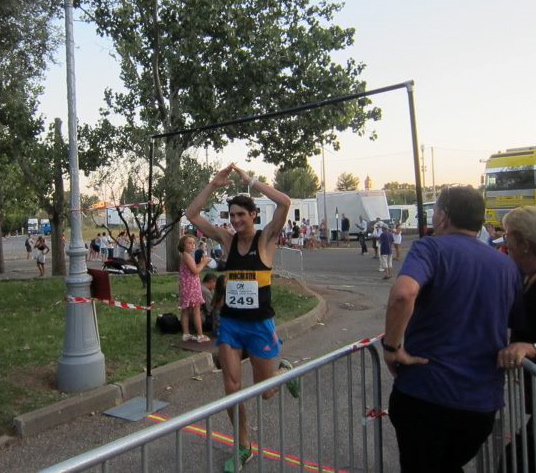
I took first place in 2:37.59, with Rich clocking 2:41.15 for 2nd and Alan 4th in 2:44.30.
I still have quite a bit to learn when it comes to duathlon: transition, bike technique, running off the bike and nutrition are some things to work on, but I definitely plan to take part in a couple of events in 2013.

Sunday, 23 September 2012

Napoli Cycle Trip


For the past few years, I’ve taken a week long cycling trip with a group of friends to various places around Southern Europe and North Africa. The concept of these trips is simple: find an airport where British Airways flies to (as BA take bikes for free) and is likely to have some good weather, book the first and last night’s accommodation there (so that we can store our bike boxes for the week), and then cycle a 5/6 day ride around the region. This year we chose to go to Naples and explore a route heading east passing through the Monte Picentini and Gallipoli Cognato National Parks before heading back to the Amalfi Coast.

Given that Naples sprawls for miles and miles, we took a train out to Salerno to avoid having to deal with the city traffic and started the cycling from there. The region by the coast is dominated by Mount Vesuvius that, in AD 79, erupted and famously engulfed the cities of Pompeii and Herculaneum. The volcano has now been dormant for almost 70 years and remains an impressive backdrop to the area.

Leaving Salerno and heading towards Melfi, we were soon at well over 700m on the quiet roads through the Monte Picentini National Park. Being day 1 and feeling fresh, we were able to climb these hills with relative ease and arrived in the town of Acerno for lunch. One thing we have refined over the years is the amount of luggage we take; quite simply a pair of trainers, change of clothing, toiletries and some tools is adequate for a 5 day trip. We each manage to fit all this into a small rucksack or panniers attcahed to the seat post, and pick up any food and water en-route; this leaves the bike light and easy to control that is particularly beneficial when you’re climbing and out of the saddle.


Having left the tranquillity of the National Park, we joined a main road that took us towards Melfi, keeping a steady 20 mph for couple of hours as we capitalised on the gradual descent that we had earned from the morning’s climb.

It seems that every town we visited in Italy was on a hilltop, with Melfi being no exception (c. 500m). This meant that the first 10 miles of day 2 were dispatched fairly quickly, before climbing for the next 40 miles towards our lunch stop at Tolve. Having refuelled, we were ready to take on the 3 significant climbs planned for the afternoon, which involved about 1400m of ascent and 45 miles of cycling.

We’d planned our route online in advance (www.bikeroutetoaster.com) and had downloaded it on to a Garmin. This meant minimal time was spent looking at the map and deliberating over which direction to go and this proved to be a great asset to the trip. However it can mean that you rely too much on technology and loose sight of where you actually heading. Having just lost about 300m and clocked up a decent 35+mph in the process, we realised the route we’d planned had us on a motorway and the only option was to return to the top of the hill and take a different route. You can always trust the map though.


We finished the day at Pierterpertosa just as it was starting to get dark, shattered but also slightly apprehensive about tomorrow’s epic cycle.

It was naive to assume that staying overnight at 900m meant a downhill start, quite the contrary. Over the course of the next hour we hit the high point for the trip at 1200m as we cycled on small roads that wound their way through the trees in the Gallipoli Cognato National Parks. This was cycle scenery at its best. Although, being on quiet roads comes with two issues: firstly, pot holes occasionally appearing and needing to dodge; and secondly, dogs guarding their owner’s property, again occasionally appearing and needing to dodge.

The hills were relentless, not once over the course of the morning were we on flat road. Instead the roads wound through tunnels at most 500m long, through more hilltop villages and we were finally beaten when the gradient hit 1:3 and had to dismount. When we stopped for lunch at about 3pm, we exhausted the bar of all their pizza, and demolished a load crisps, chocolate and coke, a staple diet of amateur cyclists!


The day finished with a 30 mile descent from 1100m down to the town of Sapri, taking in the sunset whilst trying our best to keep up with the speed of the cars. 3 days down, 280 miles and 7000m of ascent had certainly taken a lot out of us. It puts a perspective on how impressive the tour riders are who complete, on average, about 110 miles per day and ascend up to almost 3000m in a day over a 3 week period (see some of the 2012 TdF stage climbs here).

In Sapri it was far busier than in the hills and also a couple of degrees warmer. The appetite for cycling had diminished a little by day 4 and, when we realised that once again the planned route had us going down a motorway, we were happy to jump on a train that took us 40 miles up the coast. After a relatively leisurely day of cycling, we arrived in the B&B well before sunset.


The final day took us along the Amalfi coast. All we’d heard about this road was that it was very impressive but also dangerous for cyclists. Ironically, it was the place where we saw the most cyclists of the whole trip and, as long as you don’t mind the numerous coach loads of tourists passing you every now and then, you’ll be fine. The views were amazing and certainly lived up to expectations; much of the road is cut into the side of the cliffs, so it means there are sharp drops down towards the sea as it winds along the coastline. Words don’t really do it justice, check out the pictures and essentially that is what its like for 25 miles.


We completed the trip in Sorrento and then caught a boat across the bay back to Naples. I’m not sure of exact stats for the trip but it was just under 400 miles and about 8000m of ascent; the only mechanical was one puncture between the 5 of us. I can definitely recommend heading to this part of Italy for some cycling, but prepare yourself for some hills!


Summary of the Summer


It’s been a while since my last blog, mostly because I’ve been taking the running relatively easy over the summer and have not had much to report on. Only in the last 3-4 weeks have I felt as though I’m over almost all the niggles left over from the London Marathon and my bike crash. Given it’s taken so long to recover form the London Marathon for the past couple of years, I may not run it in 2013 so that I could give myself a shot at the track next summer. But that is a long way off, so I’m not making any decisions until December at the earliest.

The A-Bot
I’ve had a few low-key races over the summer: a couple of corporate races in London and a 10k in the south of France that I ran whilst on holiday there. At the end of the France race, I was interviewed in front of the crowd at the presentation where my French stretched as far as “Yes, it was very hot. And yes, I enjoyed watching the Olympics - Christophe Lemaitre is very good”. It did make me think that perhaps a post-race interview could be something to introduce at presentations at races in the UK, where perhaps the male and female winner could be interviewed about how their race went.

The cross-country season will soon be upon us and I’m planning on racing as many of the Met League and Hampshire Leagues as possible. With the odd road race thrown in too, it should be a fairly busy autumn.

Tuesday, 24 July 2012

Countdown to London 2012


My first post on this blog highlighted the commitment and dedication required by athletes to get themselves to the top of their sport and to earn themselves a place to compete at the Olympic Games. Now, with just 3 days left until London 2012 starts, the athletes are in the final stages of preparation for the Games, there is a buzz in London that something very special is about to happen and everyone is looking forward to witnessing one of the greatest sporting events in UK history.

I plan to watch a lot of the action - the BBC is streaming 2,500 hours of sport on 24 channels over the whole 17 days and there are a number of opportunities to watch the free events such as the marathons and cycle racing. However there are a few events that I am particularly looking forward to.


Men’s Cycling Road Race - Saturday July 28th
Following Bradley Wiggins’ great victory in the Tour de France last week, members of Team Sky will be switching into team GB kit and will be joined by David Miller and Ian Stannard to help give Mark Cavendish the best opportunity to win Gold. The GB cycling team will need to work together to chase down any breakaways during the 9 laps on Box Hill and will need to assemble a lead out train that will launch Cavendish to glory on the Mall after 250km of riding. Australia will be trying to help Matt Goss sprint for the line, whilst Peter Sagan and Andre Greipel, both fresh from Tour de France stage victories, will be challenging for the gold……and that’s assuming there’ll be no breakaways.

Women’s 100m Hurdles - Tuesday August 7th
Up until last week, Sally Pearson was undefeated in 2012 and was odds on favourite for Olympic Gold. However, an in form Kellie Wells took victory at the Diamond Grand Prix in London, clocking 12.57 compared to Pearson’s 12.59. I still do not doubt that Pearson will win Gold, she is world lead this year, showed the potential at Deagu last year that she could challenge the world record and it would be great if she could achieve that in London on August 7th.

Men's Triathlon - Tuesday August 7th
Triathlon is a relatively new Olympic sport, having been introduced into the programme in Sydney 2000. This year in London, there will be some significant sibling rivalry as Alistair and Johnny Brownlee take on the rest of the world, as well as each other. Johny goes to the Olympics off the back of a number of ITU victories, while Ali has been training his way back from injury with only one race (and victory over his brother) under his belt. And training to be the best at triathlon takes a lot of time: apparently the Brownlee brothers train 35 hours a week across running, swimming and cycling.

Men’s 5,000m - Saturday August 11th
The growth in the depth of 5,000m in the last 10 years is staggering; 18 out of the top 25 times have been set in since 2003, and 230 out of the 300 sub 13 minute times have been set since 2000. Britain's best hope of Gold lies with Mo Farah who, with a pb of 12:53 set in Monaco last year, goes in to the race as one of the favourites. The 5,000m can be run tactically and can result in a burn up over the last 800-1200m or can be won from the front. Mo has proved that he is capable of winning whichever way the race goes however, with Bernard Lagat, Tariku Bekele (Kenenisa’s younger brother) and Dejen Gebremeskel in the line up, expect a competitive run from the gun. 

Of course I’ll be interested in a whole load of other action: 
- Will Michael Phelps become the most decorated Olympian ever if he wins his 19th gold medal?
- Will Usain Bolt retain his 100m and 200m titles?
- Will the in form Christophe Lemaitre cause a shock in the 200m?
- Will Paula Radcliffe capture the only medal that eludes her?
- Will David Rudisha set a new World Record in the 800m?
- Will Rebecca Adlington win both the women's 400m and 800m freestyle?
- Will Gabon beat South Korea in Group B of the football?……..

The list goes on, but its certainly going to be a great 2 weeks.


Monday, 2 July 2012

Looking back on the Ironman


Two years ago this week, five friends and I took on the challenge of the Ironman. This was the culmination of 5 years of training: starting with a cycle ride from Kings Lynn to Winchester where we averaged about 60 miles a day, and finishing with all 6 of us completing the 2.4 mile swim, 112 mile bike and 26.2 mile run of the Nice Ironman.

It terms of proudest achievements, this takes a top 3 spot. In terms of toughest things I’ve done, this definitely takes number 1 spot. I used to think that I’d ‘hit the wall’ in the marathon when my split times for the final few miles dropped by 30 seconds per mile – certainly not. Me ‘hitting the wall’ was the inability to run more than 500m at a time, take on any fuel and still have 6 miles of an Ironman marathon to run.

Despite the pain at the time, it was totally worth it and, looking back on the race, there is a small part of me that says there is still some unfinished business with the 10 hour barrier being so close.

If you want to read more about the build up to the event, we kept a log of it all here, and below is a video of the Ironman day itself.


Saturday, 26 May 2012

Crash!!!!!!


After 5 weeks of not running, I’d built myself up for my post-marathon return on Sunday 27th May. The rowing, cycling and swimming I’ve been doing has helped keep a good level of fitness and that, combined with a bit of speed work, should have got me back to running more or less full speed by July.

As I mentioned in the previous post, I’d been hitting Regents Park this week on the bike, and Wednesday was no exception. There were loads of cyclists out there that evening and, at one point, the group I was in had got up to 8 people (that is a lot for week night in Regents Park). Anyway, riders had come and gone, and I was in a group of 3 keeping a fair pace. We’d been averaging well over 20mph and it was my turn on the front.

There’s a part of each lap that is gently downhill and the group of us were cycling at 25+mph down this section. In a split second, I remember 3 distinct events: firstly, a car suddenly appearing in my way and me having the realisation that I was heading straight into it; secondly, smashing into the car, being thrown into the air an thinking to myself ‘please don’t land badly’; and thirdly, that impact on the ground, with my immediate reaction to check, and so thankfully feel, that my arms and legs were still able to move.

I was in a lot a pain and my body pretty beaten up, but surprisingly had very few cuts.  I had however left a massive dent in the car I’d hit (I’d love to get a picture of that to see just what impact I made), and I can only think that that the car had taken away most of my speed so that when I actually hit the ground, I was hardly moving forward and hence avoided any abrasion on the road.

The reaction of the public was amazing. Within the space of a couple of minutes, a doctor was checking my breathing, an anaesthetist was making sure my body was completely rigid and was holding my head in a firm position (a major concern about these types of crashes is the impact on the neck/spine from any movement, even after the event), I’d had a load of clothes and blankets thrown over me, my family had been contacted and the ambulance was on its way.

The paramedics arrived, took over, gave me a neck brace, put me on a board (this is a completely rigid stretcher which prevents the body from moving) and took me off to University College Hospital. I had loads of checks on my back, neck and stomach, and remained on the board for hours until the x-ray results had come back and the doctors were sure that there were no spinal problems.

I was discharged from hospital the following day with a suspected broken wrist and very inflamed right quad and glute. Running is back off again and round 2 of the post London Marathon rehab is underway. At least that gives me 4 months until the cross-country season starts!

I am so grateful to everyone that helped me: the guys who I was cycling with (who I’d never met before) that got in touch with my family, looked after my bike and checked how I was doing the following day, the anaesthetist who refused to stop holding my head in one place until the paramedics arrived, the off-call doctor who did a first assessment of my injuries, my sister who came to A&E to hang out with me until I went up to the ward, and all of the people from the emergency services.

Don’t let this deter you from cycling, just be careful and always wear a helmet. I’m certainly going to be back on the bike as soon possible.


This is my front wheel. And below is the car damage