Sunday, 2 June 2013

Deva Triathlon Race Review

One of my aims for this year is to compete in the World Age Group triathlon championships in Hyde Park in September. In order to compete there, its necessary to be selected from one of the three qualification races: Deva Triathlon, Liverpool Triathlon and Dambuster Triathlon. I managed to get a place in two of these, with the first one being Deva.

Having had a decent month of running and racing in March, I've since battled with a leg injury that has stopped me from running until about 2 weeks ago. Though what this has meant is that I've been able to put more miles in on the bike and, given this has been my weakest discipline out of the three, its been really worthwhile.

The Deva Triathlon takes place in Chester with the swim up and down the River Dee. The 30-34 age group was off at 7:15, so it meant a nice early start to get ready and fuelled up. The River Dee was absolutely freezing at 14 degrees! Despite not having done a triathlon for a couple of years, you don't forget that the start can be quite manic and so I chose to position myself in the middle of the river and well away from the bulk of the swimmers closer to the shore. I started steady and after about 600m began to move through the field. I landed up swimming pretty much the whole discipline solo, obviously missing out on any of the benefits of swimming in someone else's wake but getting out of the water fairly relaxed......and VERY cold!

This is one reason why my first transition was a bit slow and I still need to learn how to do the whole mounting the bike with the cleets already clipped in. Anyway, I got out on the bike and started to head south out of Chester and towards the Welsh boarder. The course was mostly flat, but had undulations now and again and I managed to keep between 23-25mph most of the way round. However my 64:57 clocking for the cycle course was a little under par relative to the other athletes finishing towards the front of the field. I know it's not great form to point the finger at your equipment, but my road bike without time-trial bars is potentially as unaerodynamic as you can get and this obviously impacts your time over 40k. I was initially surprised that 95% of the bikes racked in transition where TT bikes, but clearly having the best equipment is one way to make valuable gains on the cycle. I took a gel at 35k to give me an extra boost for the run before heading into second transition feeling relatively good.

My second transition was far better than my first and I was soon out on the run. The run is by far my strongest discipline and it keeps me motivated chasing down the other competitors. It took the first 2-3k before I completely found my rhythm, but that's no bad thing as it helps to keep it controlled straight off the bike. My pace was understandably quite a bit slower compared to what I ran at Bupa 10,000 the week before however it was all about finishing in the top 5 to get a qualification place for Hyde Park.

I landed up coming in 9th in my age group in a time of 2:08:12, so no place in Hyde Park guaranteed, but I'm keeping my fingers crossed for a roll down place. Next stop is Liverpool on July 14th and in the meantime I should work on my transition and the bike.

My results:

Discipline Time Discipline Position Discipline Cat Position Discipline Gen Position Fastest
Swim 26:12 96 19 82 82
T1 1:54 - - - -
Cycle 1:04:57 145 20 144 58:22
T2 0:41 - - - -
Run 34:15 4 1 4 33:30
Overall 2:08:12 40 9 40 2:01:23


Friday, 29 March 2013

Racing back to fitness


Back in November 2012 I went to the Canary Islands for some warm weather training. Having had good week of running, 2 days after returning home, I started to get to a nasty pain in my lower back. Initially I thought I’d just strained a muscle from overtraining and it would recover fairly quickly, however the pain persisted through December and January. I was not able to run during this period and, despite several trips to the physio, the pain was not going away so I eventually got scan. This revealed a stress fracture in my sacram (a bone in the lumber region of the back); at least I now knew the problem and it would be down to me to assess when I could get back to running again.

I find it hard to completely give up exercising while injured, so over the period of December to mid-February I concentrated on other sports. A typical week included a long cycle out to Box Hill at the weekend, a couple of swim sessions and 70k a week rowing on a Concept 2. I had no idea how the latter would provide benefit to running as it mostly works other muscle groups, however I find it to be the only way I can push myself anywhere near as hard as I do when running.

By mid-February, the pain in my back had subsided significantly and I started to work in 30-minute runs every other day. Over the next 4-5 weeks, I steadily increased the mileage and speed with the target to race at the Eastleigh 10k. While my legs weren’t exactly used to running, the cross-training had helped maintain a decent level of fitness.

Having not competed for 10-weeks, I was well up for a race at Eastleigh. Conditions were absolutely freezing and a little breezy. After a fairly quick first kilometre, Ross Murray (who eventually won) broke away with a couple of other runners, leaving myself in a group of three along with Dave Norman and Kyle Hackett. This certainly helped to maintain a decent pace and push on hard over the whole distance. My lack of speedwork meant that I struggled to put up a decent fight over the last 400m, but I was pleasantly surprised to finish in 31:22…..perhaps all the rowing transferred better than expected.

Today I ran in the Maidenhead Easter 10 mile. Again it was cold and windy, but at least sunny. There was not quite the same depth as at Eastleigh and perhaps I started a bit quick trying to keep up with Olympian Anuradha Cooray. Having gone through 5 miles in little over 25 minutes, I lost a bit of concentration from 8 to 9 miles and eventually finished 3rd in 51:59. I probably need to focus on some strength endurance now but it seems that running is certainly now moving in the right direction again.

Sunday, 20 January 2013

2012 Review and 2013 Target

2012 seemed to have just as many highs and lows as 2011, however the highs were far greater and the lows worse. In my review of 2011, I gave myself 4 main targets to go into 2012 with: an England vest, a sub 31 10k, a sub 67 half marathon and a sub 2:23 marathon. Everything came together in the first 3 months of the year, running off 6 months of unbroken training, finding a good routine to balance work and exercise, and having set targets to aim for. I only landed up achieving 2 of these targets, however being selected and then racing in an England vest at the Elgoibar cross country has to be one of my top running memories. It is something that I feel privileged to have had the opportunity to do and gave me exposure into what racing within a strong international field is like.

The London Marathon was an obvious highlight of the year and I felt that my experiences from previous marathons allowed me to train sensibly and then run consistently on the day. I think the marathon has a huge mental element to it; whether its in the preparation, such as putting in miles of marathon paced running at the end of a session at a dark New River Track, or in the execution, such as beating the pain in the closing stages. However the physical impact on the body is something that has bothered me for the last two years, ultimately leaving me in pieces in the months following the marathon. My own body can’t seem to handle the months of high mileage that culminate in a 26 mile road race. I don’t think its worth racing if you’re not prepared to put in the work to achieve the desired outcome (in my a case a pb), and hence my 2013 race schedule won’t include London.

The low point of the year came in May when I was involved in a nasty bike accident. I still cannot believe that my injuries were so insignificant following a 30mph crash and count myself as being pretty lucky to have come off so lightly. It has made me appreciate two main things: (i) the fine line I take everyday cycling in London where you can’t prepare for the actions of other roads users and (ii) that there is a lot more to life outside of running and it might just take an accident such as mine to be able to appreciate this.

In fact my total running mileage for the year was only 1759, very slightly lower than the 1852 in 2011 and for 5 months of this year I’ve averaged less than 15 miles of running per week. However I've been pretty unphased by this and as a result have been able focus on progressing my career and putting in more time cycling.

This has influenced my targets for 2013, with the main goal to qualify for and race the 2013 age group triathlon championships taking place in Hyde Park in September. It will require concentrating on shorter running distances and spending even more time on the bike; I might even start doing some swim interval sessions but not sure whether I'll have the willpower for that at 7 in the morning! I am hoping that this will also reduce my chances of spending long periods of time out injured and will break the routine of the annual 26 mile run round London that I've done most of the past 10 years. This is quite a different target to 2012, but fingers crossed it'll come off.

Saturday, 1 December 2012

Seb Coe book review and another bike crash

What is with me and falling off bikes? Yes, this week I had another accident on my bike. Someone who'd had a few drinks decided to cross the road without looking just as I was cycling past and I had nowhere to go but straight into them (they came off fine). A trip to A&E, 5 stitches on my chin, a bashed calf muscle and a few other grazes has sidelined me for the week, but I'm hoping to be running again in the next 7-10 days.

I'd just come back from warm weather training in a resort called Las Playitas in the Canary Islands. Its a really good set up with some great running trails, gym, sportshall and 50m pool, and it alowed me to put in a solid week's trainign along with a load of sleep and relaxing. While I was there I read Seb Coe's autobiography 'Running my Life' and here is a short review of what I thought of the book:


From setting 3 world records in the space of 41 days to being one of the key figures to deliver the 2012 London Olympics, Seb Coe has some significant achievements to his name. Unlike many celebrities, Seb Coe started to achieve big from a relatively young age; he was just 22 when he broke his first world record. This makes his autobiography a thrilling read based upon his achievements from the past 30 years.

The book is essentially split into 3 main sections: his life as an athlete, his life as a politician and his role in the run up to the 2012 games. It provides an insight into what is required of a full time athlete, his relationship with his father (who was also his coach) and the influences of others within athletics to make the early 80's possibly the most competitive period for middle distance athletics.

We read about his time as an MP and the difficulties he has in balancing both work and family commitments. For me, this was a part of his life that I was most unfamiliar with. However, from reading the book, it is clear that the skills he learnt during this period were instrumental in helping him deliver the London 2012 Olympics.

And finally we are reminded of his role at the Games, how the bid was won in Singapore in 2005 to the closing ceremony of the Paralympics. It's fascinating stuff, and also brings back memories of a great summer of sport. There is still a gap for somebody (such as Paul Deighton, CEO of LOCOG) to do a complete analysis of the games, however it's quite right that Seb Coe does not go into this great detail here.

Likewise there is limited controversy in the book, and I would not expect it to appear in an autobiography for somebody with potentially so much high level exposure ahead I them. However, it does recognise events that have indeed challenged the author and leaves the reader to research further on them if required. As a runner, there were large parts of the book that I could directly relate to, but I would think that a non-runner following sport and sporting achievments would find it just as interesting.

Who knows what else he might achieve? President of the IOC is possibly up there but, even at the age of 55, this book still describes a very interesting life so far and is definitely worth a read.

I'll leave you with a clip showing some of the battles between him and Steve Ovett from 1980: http://www.youtube.com/watch?v=txkz8VLO3iE

Saturday, 24 November 2012

Duathlon Racing

It was after the first Met League XC when I was in the pub with Rich Phillips and he mentioned to me that he'd entered the Ballbuster duathlon. I'd never actually done a duathlon before and the prospect of 16 miles running and 24 miles cycling was pushing the sort of endurance required for a marathon; certainly not the focus of my current training. Having been convinced the course favoured runners and followed the same stunning route that the Olympic Road Race took around Box Hill, my name was down for it. I then convinced my Winchester club-mate, Alan Murchison, who has been trying to get me to race a duathlon all year, to sign up as well; he too was equally apprehensive about the 16 mile run.

The previous week Rich and I had gone to recce the bike course. It was a filthy wet Sunday, the road was covered in leaves and, if it was like this the following week, coming off the bike could be quite likely. It was good to get an understanding of the course, where you could push it on the bike, where you needed to hold back and the magnitude of Box Hill.

Roll on a week and we were fortunate to have a stunning November morning. Temperatures were only just above freezing, but it was clear, dry and the organisers had done a good job of clearing the debris from the road. With the race starting at 8am, my alarm had gone off at 4:30am to give sufficient time to arrive on the start line fairly relaxed.


Having to prepare for both 16 miles running and 24 miles cycling meant getting the right clothing was key: too many layers and you'd overheat on the run, too few and the wind chill on the bike could bring your core temperature down and consequently impact performance. I went for a long sleeve t-shirt, arm warmers and a tri-suit.

We set off towards Headley Common on the first of the five 8-mile laps. This was a race that was going to last well over 2.5 hours, so I held back on the fast pace set by the early leaders and sat in at 6-minute miling. After a couple of miles, the pace at the front slowed and Rich and I pushed through and started to put some distance between us and the rest of the field. It was important to capitalise on our running strength given that there are invariably always competitors who are very strong cyclists, and they can easily take minutes out of you whilst on the bike discipline. I was also a little concerned that Rich is both stronger than me on the bike and normally (although not necessarily on this occasion) very efficient in transition, so feeling good, I pushed on the pace going up Box Hill and started to form a reasonable lead.


Transition was fine and I was out on the bike keeping a steady 20mph and working hard to make sure I stayed warm. The bike discipline has always been my weakest when it comes to triathlon and, with my only cycling miles since September having been done commuting the 6 miles to/from work on a 30 year old racer, preparation for the Ballbuster had been limited. The upside of this is that when I switch to my 'proper' racing bike it feels like it weighs nothing.

I thought that as long as no one over took me within the first 1.5 laps of the 3 lap bike course, I'd be able to catch them on the second run. It came as a bit of a blow when Hugh MacKensie overtook me half way up the Box Hill climb on the first lap. This didn't deter me from holding back and I wanted to make sure I lost as little ground as possible on the new leader. The added complexity on the second and third laps was the other cyclists on their first and second laps respectively, and having to yell out that a faster rider was coming through on the right.

After 3 laps, I ditched the bike and got out on the second run. Someone yelled out to me that I was 2 minutes behind the leader; not an unreasonable gap to catch up, but one that would require a big effort. As a novice duathlete, running off the bike is not something I've practiced and it took a couple of miles before my body had adjusted itself between the two disciplines. I couldn't see the leader, nor could I see who was behind me in 3rd, so dug in and simply aimed for a decent second run-split. Some 4 miles into the second run, someone yelled out that I was only 90 seconds behind, so I was catching but not quick enough. However only a few minutes later I took the lead, passing a tired leader. I felt good and was actually looking forward to the final ascent up Box Hill.


I took first place in 2:37.59, with Rich clocking 2:41.15 for 2nd and Alan 4th in 2:44.30.
I still have quite a bit to learn when it comes to duathlon: transition, bike technique, running off the bike and nutrition are some things to work on, but I definitely plan to take part in a couple of events in 2013.

Sunday, 23 September 2012

Napoli Cycle Trip


For the past few years, I’ve taken a week long cycling trip with a group of friends to various places around Southern Europe and North Africa. The concept of these trips is simple: find an airport where British Airways flies to (as BA take bikes for free) and is likely to have some good weather, book the first and last night’s accommodation there (so that we can store our bike boxes for the week), and then cycle a 5/6 day ride around the region. This year we chose to go to Naples and explore a route heading east passing through the Monte Picentini and Gallipoli Cognato National Parks before heading back to the Amalfi Coast.

Given that Naples sprawls for miles and miles, we took a train out to Salerno to avoid having to deal with the city traffic and started the cycling from there. The region by the coast is dominated by Mount Vesuvius that, in AD 79, erupted and famously engulfed the cities of Pompeii and Herculaneum. The volcano has now been dormant for almost 70 years and remains an impressive backdrop to the area.

Leaving Salerno and heading towards Melfi, we were soon at well over 700m on the quiet roads through the Monte Picentini National Park. Being day 1 and feeling fresh, we were able to climb these hills with relative ease and arrived in the town of Acerno for lunch. One thing we have refined over the years is the amount of luggage we take; quite simply a pair of trainers, change of clothing, toiletries and some tools is adequate for a 5 day trip. We each manage to fit all this into a small rucksack or panniers attcahed to the seat post, and pick up any food and water en-route; this leaves the bike light and easy to control that is particularly beneficial when you’re climbing and out of the saddle.


Having left the tranquillity of the National Park, we joined a main road that took us towards Melfi, keeping a steady 20 mph for couple of hours as we capitalised on the gradual descent that we had earned from the morning’s climb.

It seems that every town we visited in Italy was on a hilltop, with Melfi being no exception (c. 500m). This meant that the first 10 miles of day 2 were dispatched fairly quickly, before climbing for the next 40 miles towards our lunch stop at Tolve. Having refuelled, we were ready to take on the 3 significant climbs planned for the afternoon, which involved about 1400m of ascent and 45 miles of cycling.

We’d planned our route online in advance (www.bikeroutetoaster.com) and had downloaded it on to a Garmin. This meant minimal time was spent looking at the map and deliberating over which direction to go and this proved to be a great asset to the trip. However it can mean that you rely too much on technology and loose sight of where you actually heading. Having just lost about 300m and clocked up a decent 35+mph in the process, we realised the route we’d planned had us on a motorway and the only option was to return to the top of the hill and take a different route. You can always trust the map though.


We finished the day at Pierterpertosa just as it was starting to get dark, shattered but also slightly apprehensive about tomorrow’s epic cycle.

It was naive to assume that staying overnight at 900m meant a downhill start, quite the contrary. Over the course of the next hour we hit the high point for the trip at 1200m as we cycled on small roads that wound their way through the trees in the Gallipoli Cognato National Parks. This was cycle scenery at its best. Although, being on quiet roads comes with two issues: firstly, pot holes occasionally appearing and needing to dodge; and secondly, dogs guarding their owner’s property, again occasionally appearing and needing to dodge.

The hills were relentless, not once over the course of the morning were we on flat road. Instead the roads wound through tunnels at most 500m long, through more hilltop villages and we were finally beaten when the gradient hit 1:3 and had to dismount. When we stopped for lunch at about 3pm, we exhausted the bar of all their pizza, and demolished a load crisps, chocolate and coke, a staple diet of amateur cyclists!


The day finished with a 30 mile descent from 1100m down to the town of Sapri, taking in the sunset whilst trying our best to keep up with the speed of the cars. 3 days down, 280 miles and 7000m of ascent had certainly taken a lot out of us. It puts a perspective on how impressive the tour riders are who complete, on average, about 110 miles per day and ascend up to almost 3000m in a day over a 3 week period (see some of the 2012 TdF stage climbs here).

In Sapri it was far busier than in the hills and also a couple of degrees warmer. The appetite for cycling had diminished a little by day 4 and, when we realised that once again the planned route had us going down a motorway, we were happy to jump on a train that took us 40 miles up the coast. After a relatively leisurely day of cycling, we arrived in the B&B well before sunset.


The final day took us along the Amalfi coast. All we’d heard about this road was that it was very impressive but also dangerous for cyclists. Ironically, it was the place where we saw the most cyclists of the whole trip and, as long as you don’t mind the numerous coach loads of tourists passing you every now and then, you’ll be fine. The views were amazing and certainly lived up to expectations; much of the road is cut into the side of the cliffs, so it means there are sharp drops down towards the sea as it winds along the coastline. Words don’t really do it justice, check out the pictures and essentially that is what its like for 25 miles.


We completed the trip in Sorrento and then caught a boat across the bay back to Naples. I’m not sure of exact stats for the trip but it was just under 400 miles and about 8000m of ascent; the only mechanical was one puncture between the 5 of us. I can definitely recommend heading to this part of Italy for some cycling, but prepare yourself for some hills!


Summary of the Summer


It’s been a while since my last blog, mostly because I’ve been taking the running relatively easy over the summer and have not had much to report on. Only in the last 3-4 weeks have I felt as though I’m over almost all the niggles left over from the London Marathon and my bike crash. Given it’s taken so long to recover form the London Marathon for the past couple of years, I may not run it in 2013 so that I could give myself a shot at the track next summer. But that is a long way off, so I’m not making any decisions until December at the earliest.

The A-Bot
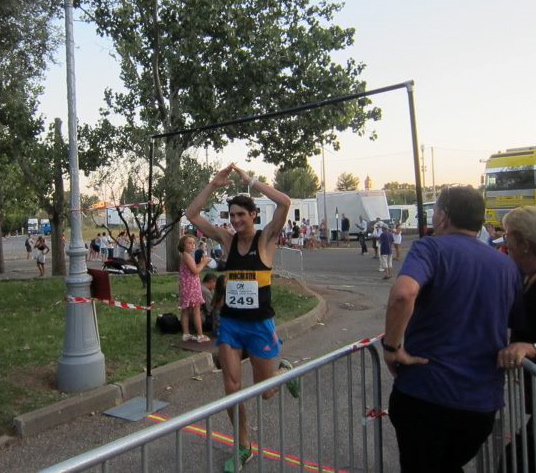
I’ve had a few low-key races over the summer: a couple of corporate races in London and a 10k in the south of France that I ran whilst on holiday there. At the end of the France race, I was interviewed in front of the crowd at the presentation where my French stretched as far as “Yes, it was very hot. And yes, I enjoyed watching the Olympics - Christophe Lemaitre is very good”. It did make me think that perhaps a post-race interview could be something to introduce at presentations at races in the UK, where perhaps the male and female winner could be interviewed about how their race went.

The cross-country season will soon be upon us and I’m planning on racing as many of the Met League and Hampshire Leagues as possible. With the odd road race thrown in too, it should be a fairly busy autumn.