Friday, 16 March 2012

Some warm weather training in Lanzarote


I have just returned from 10 days warm weather training at Club La Santa on the island of Lanzarote. I was part of a group of 100 members of the Serpentine Running Club who'd gone to Lanzarote for some swim, bike and run training. We take club coaches across each discipline and this helps encourage everybody to train together, adds structure to the week and can provide athletes with various training techniques/sessions that they can bring back to the UK.

My personal aim for the week was not to use the additional time to pack in significantly more mileage, but to allow my body to recover completely after each session. This is something that I find difficult to include in London; trying to juggle 70 miles running, 20 kilometres swimming and some long hours, it often means that its the recovery/sleep gets the chop.

Below is the training that I completed in the last 7 days. In particular, the sessions and long Sunday went well, and I feel its given me the confidence to be able to realise my goal for the London Marathon. These have been:

The total run distance for the week was 81.5 miles and the total swim distance was 19.4k. While not too dissimilar to the sessions I have been doing in London, I have been able to supplement these with a fair amount of strength and conditioning work. I have a 30 minute routine that involves planks, lunges, squats, press-ups, sit-ups etc. with each exercise taking between 3-5 minutes. The load on each exercise is small, and I feel that the benefit from conditioning these relatively low utilised muscles is invaluable and a contributing factor to preventing injury.

Despite it being a relatively tough week, I am returning to the UK feeling refreshed and in a good mindset, first for the Eastleigh 10k on Sunday, then probably for a marathon paced effort at Reading Half, before hitting the taper into the London Marathon.

Saturday, 3 March 2012

Hyde Park Relays - Greenleaf family tradition since 1963....


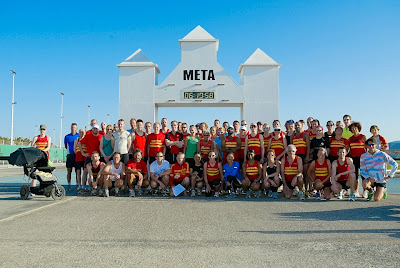
Ten years ago I ran in my first Hyde Park Relays as a 1st year student for Nottingham University. That year we came 7th overall and the picture on the right shows me handing over to Ed Jackson, who ran the 3rd fastest time that day. Since then, I have tried to compete in the race as frequently as possible as it’s always a great event from the Uni Relay calendar.


My parents often come to watch the race, and my Dad always has had a particular interest in the event as he competed in the winning team in 1963. That year Ron Hill helped lead their Manchester Team to victory and a course record. He writes an interesting perspective about the race in his book “The Long Hard Road - Part One: Nearly To The Top”


I also found the article about the race from the Imperial College internal newspaper: http://felixonline.co.uk/archive/IC_1963/1963_0189_A.pdf

In addition to Ron Hill, the Hyde Park Relays has seen several other famous running names compete over the years, including Herb Elliott, Seb Coe, Richard Nerurkar and John Mayock.

In 2012, I was running in a team for my company, Capco. With about 300 employees in the UK, we have 29 different sports teams, including one for running. These sports teams provide a great way to get to know your colleagues away from the office and allow us take part in events where everyone shares a common interest.

The good weather brought loads of people out into Hyde Park, so there were a fair few dogs and people to dodge on the 3.2 mile loop. I think Cambridge won the race overall, with Glen Watts clocking the fastest time in 15:38. Frustratingly for me, that was just 3 seconds faster than my time, but I had no idea this was the case as I was running leg 1 and he was running leg 5.

High fives to the Alan Hall and his team of Imperial College for putting on a great event!

National Cross Country 2012

Conditions at Parliament Hill could not have been better to draw the crowds to watch over 4,500 runners competing the National Cross Country, some contrast to the mud and bog at Alton Towers last year. This fixture in the cross-country calendar provides runners of all abilities, from novices to Olympians, to compete alongside one another in the same race.

I first ran the National as a senior in 2005, where I finished in 218th; I came 78th last year; and I was hoping for some further improvement this year. Given there were almost 1700 competitors in the Senior Men’s race, it was important to make a fast start to prevent being boxed in, as the width of the course narrows significantly after just 400m.

It took most of the first lap before everyone settled down into their position as fast starters faded and slower starters move gradually through the field. After 6km, I found myself in a group of runners including Darren Deed, Dave Norman, Chris Smith and Phil Hinch; all very good club runners whom, until this year, I was nowhere near being able to compete against.

Running within a group means that you constantly feel under pressure to stick with the pace and any lost concentration can see you rapidly fall off the back. While physically very demanding, it’s likely you will maintain your place in the field, or even move to a higher position. I managed to stick with the group until about 10km before the fatigue started to build in my legs and I knew full well that I was struggling to keep up. However, I refused to give in and the gap hardly widened all the way to the finish. There was no respite all the way to the end either, as other runners were packing in close behind and any loss of focus would easily have seen me drop 5 places.

I came 31st overall in a field of 1689. There are great videos of all the races at http://www.athleticos.org/coverage/248314-2012-National-Cross-Country-Championships……certainly some inspiration for racing in 2013.

Sunday, 12 February 2012

Cross country smackdowns and the psychology of winning

Six weekends into 2012, and seven races already completed, has meant it’s been a busy start to the year. Two races in the last few weeks have really made me think about my approach to racing and my desire to win, these being the Southern Cross Country (Stamner Park, Brighton) and the Met League (Perivale).

I'll start by congratulating Highgate Harriers on a fantastic win at the Southern Cross. Their squad always shows a great team spirit, and they have fielded a competitive side at all major club races during this 2011/2012 season. They are a team that certainly deserved to raise the Frank Wynn Challenge Cup.

Keeping with Highgate theme, I had my first of two battles with Shaun Dixon at Stamner Park. The course provided a good mix of hills, woodland, mud and fast descents, so it meant staying focused throughout the entire 15km to ensure any attack by a competitor was reacted to immediately.

The race saw a large group of 10+ athletes pull away from the rest of field and establish a 50m gap soon into the first lap. I was happy to sit back in the 20's with the plan to work through the field as the race evolved. I soon found myself running with Shaun, who seemed to be following a similar strategy, and it was good to work together and chase down the fast starters.

By the start of the second lap, the field had thinned, and the target was to catch Darren Deed and Steve Naylor of Bedford. Continually pushing one another, we eventually caught them with about 2km to go. At this point, the race turned from one where we were working together to one where we were fighting for position. Going into the finishing straight, I was sitting in 9th; crossing the line, I was in 11th. Both Shaun and Darren had got me in a sprint finish and I appreciate that is an area that I need to work on. Was it that I simply could not physically achieve that 9th place, or had I made a conscious decision to settle for defeat?

The next race was the Met League at Perivale. OK, this is not of quite the same prominence as the Southern Cross, but the principle of racing for the win was the same. After the first lap, Shaun and I had put 25 metres into the rest of field (a gap that would more or less stay the same throughout the race). I knew that Shaun had a strong finish and I spent much of the race questioning how best I could achieve the win. I decided that I had to push the pace from 800m out, but that simply was not good enough and, with 50 metres to the line, I was pushed into second; again failing in a sprint finish. Again I find myself questioning whether I had subconsciously settled for 2nd place early on in the race, based upon my knowledge of competitors finishing ability.

So this brings me to the physcology of winning and a topic discussed in Tim Noake’s ‘Lore of Running’ called the ‘Central Governor Theory’. Take this statement with a pinch of salt, but I believe that I could have won the Met League had I focused my mind properly.

Tim Noakes claims that it is not your body that determines whether you win, but your brain. As a human, our brains are programmed to obtain success and evolution has brought us to push ourselves physically as hard as possible without killing ourselves. The brain is simply a regulator to prevent us from inflicting too much damage on ourselves, and this is our Central Governor. Some people genetically have a greater tolerance to pain, and therefore a greater Central Governor. However your Central Governor is also impacted by your will to win, or your self-motivation or how important the race is. So perhaps the greater I wanted the win, the greater the level of discomfort I could take through the of fatigue my muscles.

Related to this is a level of self-belief, whereby humans will generally respond in the same positive or negative way if faced with the same situation again. OK, I have now lost out in a sprint finish to the same person in the last two races. However what I must not loose is my positive self-belief, whereby if faced with the same situation again, I must learn to react differently and realise my full potential. Roll on the National!
Sunday, 5 February 2012

Treadmill training

To say this week has been freezing in the UK is an understatement, its been properly baltic! In conditions like we have seen this week, it makes sense to move some or all training indoors and on to the treadmill. I used to be very dubious of the treadmill, running outside for over 10 years before even stepping foot on one, however treadmill running has now become a key part of my weekly training.

While skeptics may say that they are boring, expensive, inaccurate and fail to properly simulate outdoor running, I feel that they provide an effective way to carry out certain sessions. Below are details of the two sessions that I currently do on the treadmill along with why I chose to run them indoors.

(1) Monday night 'easy' threshold:
10 min warm up (14km/h - 16km/h)
30/40 minute threshold (18km/h)
10 min warm down (16km/h-10km/h)
Total: 14.5-16.5km

Living in London and not finishing work until after dark during the winter means that my running routes are limited, are stop/start due to having to cross numerous roads, are poorly lit and are often done solo. This treadmill session allows me to switch off from such distractions without losing the speed. I run controlled in this session as I do not tire myself out for Tuesday night track. And through running this session in front of a mirror, it also allows me to check that my body and legs are aligned and that I am not developing any bad running habits.

(2) Thursday night building sess:
10 min warm up (14km/h - 16km/h)
40 minute build (18km/h - 19.5km/h, incrementing by 0.5km/h every 10 minutes)
10 min warm down (16km/h-10km/h)
Total distance: 18km

This session simulates running at race pace (or slightly faster) on tired legs and helps them get used to turning over at a high frequency than is natural. I find that incrementing the speed every 10 minutes breaks down the 40 minute block into manageable chunks and this helps maintain my focus for the session. The treadmill ensures that I stay at, or close to, the required pace; something that I could not necessarily guarantee if running outside.

I appreciate that treadmills may not be for everyone, but they can have their place in an athletes schedule. And even if you aren't an athlete, then those creative ones amongst us can still find a use for them here

Saturday, 28 January 2012

A Basque Adventure

Running for England had been one of my big aims for 2012; I just never thought I would achieve it so early in the year. I had been selected to represent England in the Juan Muguerza Cross Country in Elgoibar, Spain. This fixture, first started in 1943, has grown to become one of the most competitive international events in the cross-country calendar with past winners including Paul Tergat, Kenenisa Bekele and Derartu Tulu.

England sent 4 teams (Senior/Junior Men and Women) and I was in the senior men’s team along with Jonathan Taylor, Jon Pepper and Phil Berntsen. On the Evening before the race, we all gathered in the town hall in Elgoibar for the elite athletes to be introduced and for past winners to be applauded – at least that's what I thought was going on, given my zero knowledge of Spanish meant just listing to the person on the mic without any comprehension of what was being said!

We arrived at the course in plenty of time for the race, allowing us to check the terrain and soak up the atmosphere of the event. A major European Cross Country is very different to what I’ve been used to in England, with the races including several laps (our race had 7 laps), huge television screens tracking the leaders, al lot of load music and bands and wall to wall commentary (again no idea of the context here!)

It was a great honour representing England and as a result I was slightly more nervous on the start line that I generally am before races. We opened with a lap of the track which, given I did 71 seconds and was already about 5 seconds off the front, gives an idea of the pace at the front. Having left the track, we headed out onto the cross-country section where all the previous races of the day had left the course very boggy. Despite appearing relatively flat, the course in fact had some nasty undulations and hills to test you. Each lap included a lap of the track which meant a huge amount of support from the crowd and playing band, it also meant running 300m on the track in 12mm spikes which felt a little odd.

The race was won by Paul Tanui in 32:25 and I finished 27th in 35:54. My team mates were: Jonathan Taylor 9th (34:19), Jon Pepper 15th (35:01) and Phil Berntsen 28th (36:00).

The whole event was a fantastic experience and a great introduction to international athletics.

Senior Men's Team (L to R): Phil, Jon,
Eamonn Martin (team manager), Jonathan, Andy

Friday, 27 January 2012

Cross Country Kick Off

2012 has kicked off with a busy January, racing every weekend. Racing so frequently is not some I generally plan to do, but due to the nature of the races and the shape I’m currently in, I’ve been happy with the busy schedule.

The Hampshire County Champs returned to the New Forest after a 2 year absence and, with former champions John Beattie and Lee Merrien lining up, it was going to be strong at the front. The course was 3 laps, measuring 12k in total, and took on all sorts of different terrains and undulations: a good cross-country course. Feeling good at the start, I settled into about 10th before working my way through the pack in to 3rd place by the time we reached the end of the 1st lap.

Throughout the 2nd lap, I was isolated with 1&2 a fair distance ahead. I did my best not to loose any ground on John and Lee, and continued to push the pace, convinced that 4th was still chasing close behind.

I lost my focus slightly towards the end of the race and the gap between myself and 1&2 widened significantly. Maintaining my focus during competition is still something I need to work on, and is another component of racing altogether. Bronze in the Hampshire Championships is my best ever position, and being beaten by two Commonwealth Games athletes I feel is no disgrace! WADAC took 2nd in the team competition missing out to Team Southampton by just 1 point.